
Understanding AML Risks and Its Categories

In the finance ecosystem, not every risk wears a red flag, some hide behind everyday transactions, quiet customers, and ordinary accounts. These are the unseen dangers that fuel financial crime, collectively forming what we know as AML risk. It’s the invisible web that connects money, people, and systems. It is a space where weak controls, unchecked customers, or overlooked jurisdictions can open doors to laundering and terrorist financing.
To truly understand how financial institutions protect themselves, one must first learn to see these risks not as isolated threats, but as interwoven patterns shaping every compliance decision. This is the lens through which we’ll explore the categories of AML risk in this blog in order to help you recognize not just what they are, but why they matter.
Definition

AML Risk is defined as the potential exposure of a financial institution—or any regulated entity—to being exploited by criminals to facilitate the flow of illicit funds generated from serious crimes such as corruption, fraud, human trafficking, or drug trafficking into the legitimate financial system.
This risk is quantified not only by the direct threat of money laundering (Money Laundering Risk) but also by the threat of funding terrorist activities (Terrorist Financing Risk). Crucially, AML risk is dynamic and multifaceted, categorized across four primary dimensions:
- The inherent danger presented by the Customer (e.g., shell companies or PEPs),
- The exposure associated with the Geography of operation (e.g., sanctioned countries),
- The vulnerability of the Products and services offered (e.g., private banking or anonymous transfers), and
- The risk posed by the Delivery Channel (e.g., non-face-to-face onboarding).
Effective risk management requires the continuous identification, assessment, and mitigation of these factors to reduce inherent threats to an acceptable residual level.
The Core Components of AML Risk
The Risk Based Approach
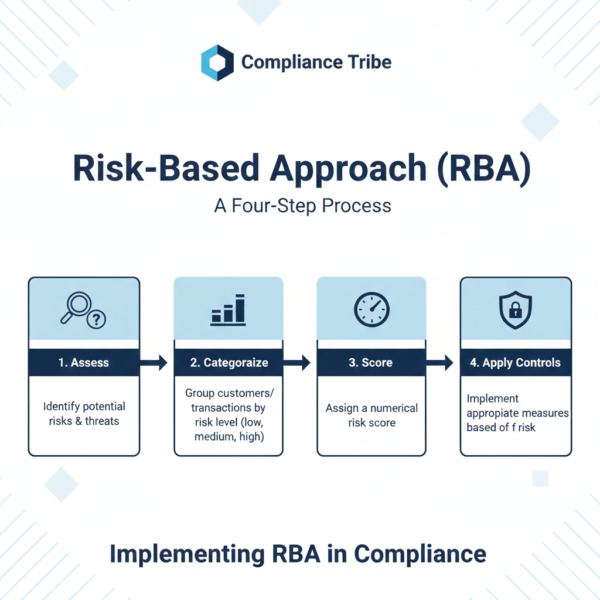
The Risk-Based Approach (RBA) is the central regulatory and operational methodology mandated by international standards, such as those set by the Financial Action Task Force (FATF). It dictates that an institution’s intensity of AML controls must be directly proportional to the risk level of its customers and services.
Legally, the RBA serves as a core compliance requirement; by prioritizing risks and applying EDD to high-threat areas (like Politically Exposed Persons or high-risk jurisdictions) while scaling back on low-risk ones, institutions demonstrate due diligence and avoid regulatory breaches.
Strategically, the RBA ensures operational efficiency: it prevents compliance teams from being overwhelmed by immaterial alerts, focuses limited resources on genuinely high-threat activities, and allows the organization to reduce its overall residual risk to an acceptable level while maintaining a smoother experience for the majority of low-risk customers.
The Risk-Based Approach (RBA) fundamentally requires risk categorization, as an organization cannot apply controls proportionally without first defining and segmenting its threats. The RBA’s core principle is efficiency: it avoids the impossible task of treating every customer and transaction as equally high-risk.
To achieve this differentiation, the RBA compels institutions to break down the broad concept of “AML threat” into granular, measurable components: Customer, Geographic, Product, and Delivery Channel risk.
How the RBA Drives Risk Categorization
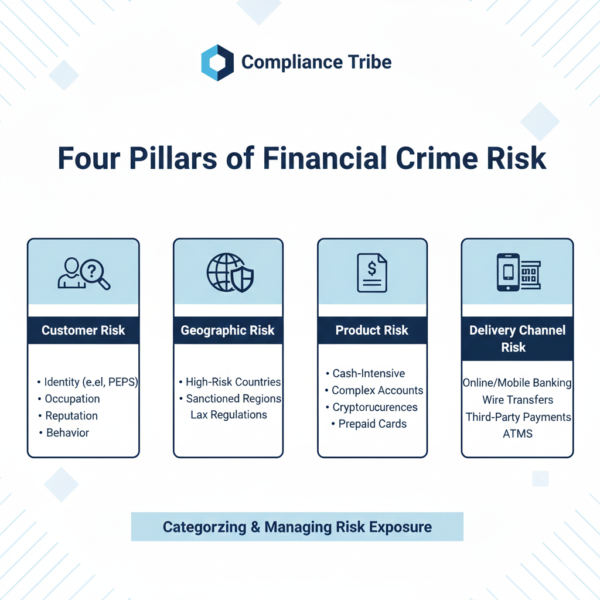
- Defines the Threat Landscape: Categorization breaks down the complex AML threat into four manageable and measurable components: Customer, Geographic, Product, and Delivery Channel risk.
- Enables Differentiation: Allows institutions to distinguish low-risk activity from high-risk activity (the essence of RBA).
- Informs Control Application: By scoring and categorizing, the inherent risk profile of a customer is calculated. This score automatically dictates the required level of due diligence, ensuring, for example, that a customer with high Geographic Risk is immediately subject to Enhanced Due Diligence (EDD).
- Ensures Efficiency: Without categorization, institutions would be forced to apply maximum, costly controls everywhere, leading to operational paralysis. Categorization ensures resources are focused precisely on the highest threats.
- Demonstrates Compliance: Regulatory bodies require institutions to demonstrate a methodical and auditable process for assessing risk. Categorization provides the transparent framework for why specific controls were applied (or relaxed) to any given client.
Inherent Risk Vs Residual Risk
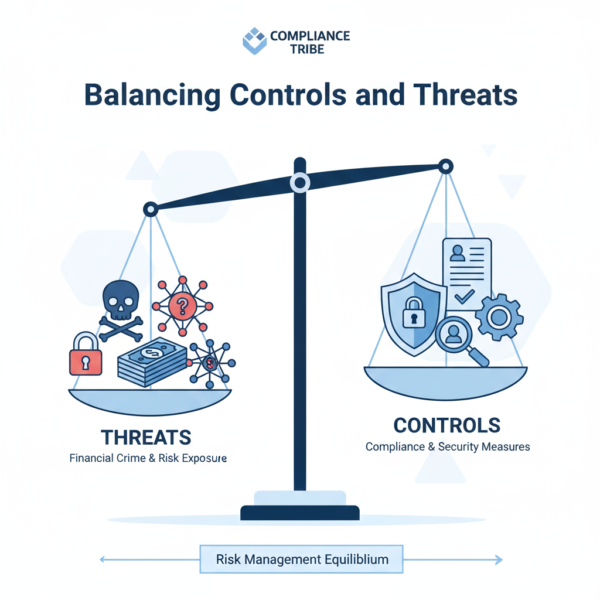
Inherent Risk: represents the fundamental level of money laundering or terrorist financing vulnerability a customer, product, or service presents before an organization applies any mitigating controls or due diligence measures. It is the raw, baseline threat that exists due to the nature of the relationship. For example, private banking services, high-value cross-border wire transfers, or clients operating in sanctioned jurisdictions carry a high inherent risk regardless of the client’s current background.
Assessing this initial inherent risk is the first step in applying the Risk-Based Approach (RBA), as it dictates the intensity of the subsequent due diligence, determining whether the institution can proceed with Simplified, Standard, or the heightened requirements of EDD to effectively reduce the threat to an acceptable level of Residual Risk.
Residual Risk: on the other hand, is the level of threat that remains after a financial institution has implemented all necessary mitigating controls, such as robust CDD, EDD for high-risk clients, and continuous transaction monitoring.
The goal of the entire AML program is to reduce inherent risk down to a residual risk level that falls within the institution’s risk appetite, as approved by senior management and the board. If the residual risk remains too high, the institution must strengthen controls—or decline the relationship altogether.
The Four Fundamental Categories of AML Risk
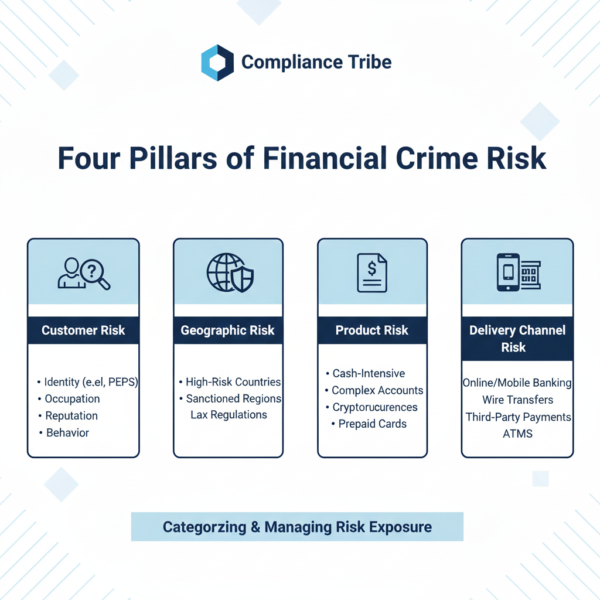
For practical application of the Risk-Based Approach, financial institutions divide the overall AML threat into four core categories that cover every dimension of a relationship, from who the customer is to how they access services. These categories: Customer, Geographical, Product and Service, and Channel and Delivery risk are used to calculate the necessary level of due diligence and continuous monitoring.
- Customer Risk focuses on the inherent threat posed by the type of client being onboarded, assessing the susceptibility of an individual or entity to being involved in illicit activity based on their public profile, business type, and control structure. High-risk triggers include relationships with Politically Exposed Persons (PEPs), who present corruption risks, and entities with opaque ownership (like shell companies or complex trusts) designed to hide the true Beneficial Owner. Additionally, businesses that are cash-intensive (e.g., casinos or high-value dealers) or those with significant adverse media or negative news headlines also escalate the customer’s risk rating, demanding a higher level of scrutiny.
- Geographical Risk analyzes the threat exposure based on the locations where a customer, their funds, or their transactions originate, operate, or terminate. This risk is rooted in the quality of anti-money laundering controls and the political stability within a jurisdiction. The highest-risk triggers are identified jurisdictions under international sanctions or embargoes (like those from OFAC), countries designated as high-risk or under increased monitoring by the FATF (Grey/Black Lists), and areas generally recognized for high levels of corruption, drug trafficking, or terrorism financing activity, as these regions introduce heightened regulatory and criminal scrutiny.
- Product and Service Risk assesses the inherent vulnerability of the financial instrument or service offered, focusing on features that make it attractive for layering or integrating criminal proceeds. Products are deemed high-risk if they inherently facilitate anonymity (such as certain crypto wallets or older systems like bearer shares), enable rapid, high-volume transactions across borders, or involve complex account management. High-risk triggers frequently include high-value services like private banking and wealth management due to their scale and complexity, as well as crucial infrastructure services like correspondent banking, which enables high-volume cross-border movement between financial institutions.
- Channel and Delivery Risk pertains to the method by which the institution interacts with the customer and provides access to its services. This risk is primarily amplified when there is a lack of physical interaction, making identity verification and authenticity confirmation challenging. High-risk triggers often involve non-face-to-face onboarding, where identity documents are verified remotely without robust digital identification technology. Furthermore, reliance on third-party intermediaries or agents (who may not have the same due diligence standards) and channels that process transactions through high-speed electronic platforms that reduce the time for human intervention also significantly elevate this category of risk.
The Mechanics of Risk Scoring
The complexity of the RBA is operationalized through Risk Scoring, where inherent risk factors are quantified and combined to produce an objective risk rating for each customer.
This scoring model is essential for ensuring consistency across the institution, automatically determining the exact level of due diligence and ongoing monitoring required to bring the Residual Risk within the organization’s approved tolerance.
- Risk Quantification is the mechanical process of translating the qualitative risks identified across the four categories (Customer, Geographic, Product, and Channel) into measurable, numerical scores that can be objectively compared. Institutions assign weighted values to specific risk indicators, such as a PEP status being assigned 20 points, or a transaction involving a sanctioned jurisdiction being assigned 30 points. These individual scores are aggregated using a defined formula to generate a total Inherent Risk Score for the customer. This score is vital because it moves the assessment beyond subjective judgment, ensuring that compliance decisions are data-driven, consistent across the organization, and easily auditable by regulators, thereby establishing a clear threshold for triggering Enhanced Due Diligence (EDD) or automated monitoring protocols.
- Mitigating Factors are the institutional controls and verification efforts applied to a high-scoring customer or product file specifically to reduce the calculated Inherent Risk down to an acceptable Residual Risk. These factors represent the strategic interventions of the AML program; they are essentially the effectiveness score of the firm’s compliance measures. For example, if a corporate client is deemed high-risk due to an opaque structure (Inherent Risk), a mitigating factor would be the successful completion of EDD, including the independent verification of the Source of Wealth (SOW) of the Beneficial Owner and obtaining senior management approval. Every effective control applied is logged to justify the final, lower Residual Risk Score, demonstrating that the institution has acted responsibly to neutralize or lessen the threat.
- Risk Appetite is the critical governance concept established by the institution’s Board and senior management that defines the maximum level of Residual Risk the organization is willing to tolerate in pursuit of its business objectives. This is a strategic decision that sets the acceptable boundaries for risk-taking across all business lines. For instance, an institution may establish a policy that no customer can have a final residual risk score above a certain threshold (e.g., 75 out of 100). This appetite acts as a fundamental gatekeeper: if a customer’s residual risk, even after applying all mitigating factors, exceeds this predefined tolerance, the compliance team is obligated to decline the customer relationship or exit the existing business, thereby ensuring the institution remains protected from excessive, unacceptable exposure.
In conclusion, effective Anti-Money Laundering (AML) defense is not about blanket suspicion, but about the strategic application of the Risk-Based Approach (RBA), which systematically demands the categorization of threat into four distinct areas—Customer, Geographic, Product, and Channel. By quantifying the resulting Inherent Risk, applying Mitigating Factors through controls like EDD, and managing the final Residual Risk within a defined Risk Appetite, institutions move beyond mere compliance to strategic financial crime prevention. Don’t let the invisible web of AML threats compromise your operations. Level up your internal defenses today: Join the waitlist for our comprehensive AML Internal Control course to master these mitigation techniques, or contact our consulting division to inquire about strengthening your corporate AML posture against regulatory exposure and financial loss.